

Next Stop: Transcendence
Southeast Asian night buses are usually a nightmare. They’re the temperature of a walk-in fridge, loud, and cramped. Once a strong smell of alcohol wafted off the driver as he walked past me on the way to his post at the front of the bus. Another time I was woken up by someone violently vomiting. It was the weirdest thing I’ve ever heard. Half yell, half barf.

Wye Valley, UK
A night bus like this is not the place you would expect to have a transcendent, life-affirming, awe-inspiring moment of clarity, something psychologist Abraham Maslow would refer to as a “peak experience.” You might expect to have such an experience at the top of a canyon or the bottom of a waterfall, yeah. An art museum or at the symphony, sure. But on a night bus? No way. And yet I had such an experience on a Vietnamese night bus.
I had become severely burnt out working as a therapist for former foster youth. I loved those kids and the never-ending troubles and trauma of my client’s lives seeped into me through my open heart. The darkness slowly extinguished my light. I felt exhausted, depleted, and couldn’t imagine a way out. After years of trying to remedy the situation with self care, vacations, therapy, and finding a rich person to marry so I would never have to work again (only kind of kidding), I gave up. I quit my job, put my things in storage, and bought a one way ticket to Southeast Asia.
Four months in, as I watched the sun set over the Vietnamese countryside from the reclining seat of a night bus, I could suddenly envision my future as clearly as the road stretched out ahead of me. I could see myself getting paid more for less soul wrenching work. I could imagine finding gentle, easy love, and building a vibrant, supportive community. More than specifics, most of all, I could taste freedom and possibility. Crowded amongst the other budget conscious backpackers, I found the light of hope.
Burnout, trauma, and significant loss can strip us of meaning, purpose, and our ability to imagine the possibility of what is to come. In fact, the DSM identifies a “a sense of foreshortened future” as a symptom of PTSD. It becomes hard for us to set long term goals because we can’t imagine ourselves into the future. If we can’t imagine ourselves reaching milestones it can be hard to muster motivation. We lose sight of what’s important to us. Our lives become lackluster and devoid of meaning and purpose.
There are ancient pathways in the UK with grooves made so deep by repeated travel over the millenia that they have become sunken roads with tall walls. Similarly, the ruts of our routines can become so deep it is difficult to peek over the edge of our well worn path. There is a saying in neuroscience, “What wires together fires together,” which means that what you do over and over becomes reflected in the actual structure of your brain. Neural pathways are reinforced with repetition. Thus it can be difficult to respond differently to stimuli in our day-to-day lives. Being outside of our routine makes it easier for us to think differently. Taking novel paths on our travels allows for novel neural paths in our brains.
The novelty of travel unlocks expansive mindsets we are unable to achieve in the humdrum routine of daily life. And through these expansive mindsets we are able to reconnect with ourselves, our values, meaning and purpose.
Perhaps philosopher Alain de Botton puts it best in his book entitled The Art of Travel:
Journeys are the midwives of thought. Few places are more conducive to internal conversations than a moving plane, ship or train. There is an almost quaint correlation between what is in front of our eyes and the thoughts we are able to have in our heads: large thoughts at times requiring large views, new thoughts, new places. Introspective reflections which are liable to stall are helped along by the flow of the landscape. The mind may be reluctant to think properly when thinking is all it is supposed to do.
At the end of hours of train-dreaming, we may feel we have been returned to ourselves - that is, brought back into contact with emotions and ideas of importance to us. It is not necessarily at home that we best encounter our true selves. The furniture insists that we cannot change because it does not; the domestic setting keeps us tethered to the person we are in ordinary life, but who may not be who we essentially are.
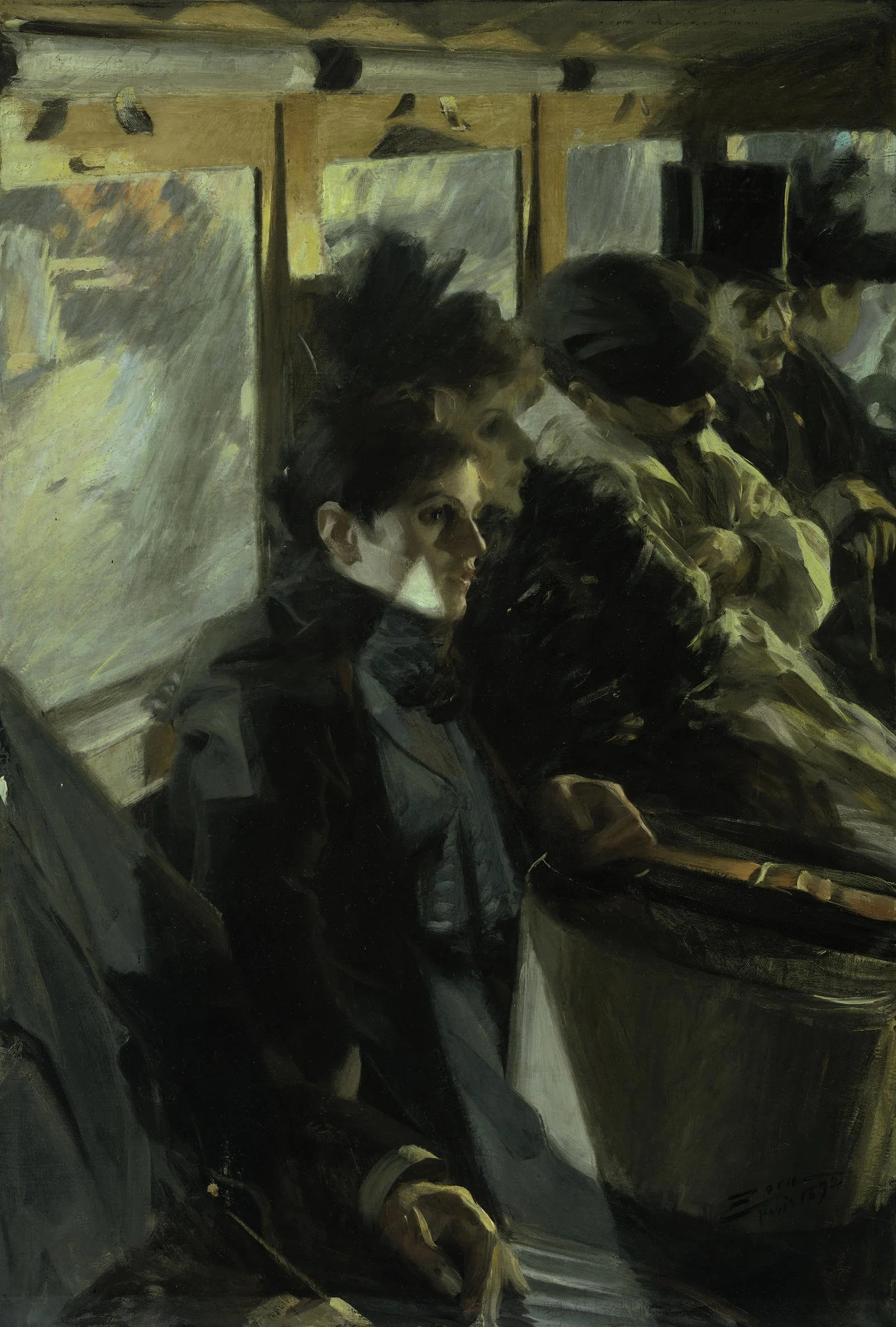
The Omnibus (1892) by Anders Zorn
You may be thinking, “How does a fleeting moment on a bus or a train or plane as de Botton or I describe meaningfully shape the course of one's life?” If I’m being honest, the beautiful memory of my future unfolding effortlessly in front of me on a Vietnamese night bus had until recently been lost to time. I was searching for something else when I found a journal entry I had written about the experience. But I have had many such experiences in my travels. And each moment of our lives nudges us in a different direction, like a lever redirecting a pinball at an arcade.
Nearly a decade after this moment on the night bus, I reconnected with a woman I met in Southeast Asia. I stayed in her Vermont carriage house and got to know the family and life she had built in the intervening years. She thanked me for encouraging her to pursue a career path while we were riding on yet another night bus in Southeast Asia. She said a comment I made stuck with her and changed the course of her life. I would argue it was less about a pithy comment, which I can’t even recall, and more about the expansive state of her mind courtesy of travel.
Days after my visit with this woman I was at the Isabella Stewart Gardener Museum in Boston and saw an image of a woman riding on a Parisian trolly, staring into the distance, lost in thought while in locomotion. It’s unknown what appealed to wealthy, eccentric art collector Isabella Stewart Gardener. Perhaps she saw what I see, the tolly and passengers in motion, the ray of light cast on the subject moving toward her mind as if it were a bolt of inspiration about to strike. For women on the move like us, it’s a familiar feeling.
After miscarriages and losing her young son in 1865, Isabella Stewart Gardener entered a deep depression. At the recommendation of her doctor, she began to travel abroad as a remedy for this depression. It was through her travels that Isabella Stewart Gardener found meaning and purpose in collecting the art and artifacts that would shape her legacy as a collector and later populate her beautiful museum. Though doctors no longer prescribe travel as a cure for depression in the 21st century, perhaps they should.
Travel reminds us of the vibrancy, beauty, and generosity in the world. The heightened senses and experiences of awe that commonly accompany travel make us feel as though we are living life to its fullest, a wonderful way to honor those we have lost and those came before us. Travel helps us reconnect to our desires, interests, and values and opens our eyes to new possibilities for meaning and purpose.