

Saint anthony
It’s morning in Melbourne and I’m about to wander the city on my final day in Australia. Do I have a plan? No. Why? Because I try to walk in the footsteps of Saint Anthony.
Saint Anthony said this:
"I'm a big believer in winging it. I'm a big believer that you're never going to find the perfect city travel experience or the perfect meal without a constant willingness to experience a bad one. Letting the happy accident happen is what a lot of vacation itineraries miss, I think, and I'm always trying to push people to allow those things to happen rather than stick to some rigid itinerary."
Oh I don’t mean St. Anthony of Padua, a 13th century Portuguese Franciscan friar, the patron saint of lost items, the poor, and travelers. No, no, no. I mean celebrity chef, author, and travel documentarian, Anthony Bourdain. Tony Bourdain is not a real saint, of course, but he is regarded as such for a certain kind of traveler, myself included. Tony demonstrated many of the values I aspire to live up to in my travels: curiosity, open mindedness, respect, and—this is a doozy for a lot of type A folks like myself—surrender.
Folks these days don’t even have to buy a Lonely Planet. For the cost of a few glugs of water, AI will effortlessly make you an itinerary. And I’m not above seeing what ChatGPT has to suggests. I like to know what the tourist hot spots are and will often visit them. It’s impossible to resist seeing the iconic Sydney Opera House if you’re in the neighborhood. But I find simply visiting the heavy hitters of tourism leaves me feeling a bit empty.
Tony Bourdain hits the nail on the head. He said, “Nothing unexpected or wonderful is likely to happen if you have an itinerary in Paris filled with the Louvre and the Eiffel Tower." It can be nice to check these places off your bucket list but the satisfaction often ends there. Places like this are often overrun with crowds, there are long lines, and jet lagged people short on patience. It can feel like a commodity for consumption; a constructed fantasy like Disneyland. And don’t get me wrong, Disneyland and the Eiffel Tower are magical, even amidst the crowds. That being said, to visit somewhere less corrupted by tourism, less manufactured, can be a very different experience. Interacting with locals and getting a sense of the culture becomes more accessible off the beaten path.
So if following a rigid, basic-bitch itinerary leaves a traveler feeling empty how does one have an experience on a trip that leaves them feeling full? Intentional travel is enhanced by a 3 step model:
Preparation: An individual considers what to expect on the upcoming journey, makes plans, and clarifies their goals and intentions.
Exploration: The trip itself; an integral but small part of the overall experience.
Integration: An individual makes sense of their experience and integrates insights into their day-to-day lives.
Since I’m currently in the Exploration Phase of my journey in Australia, this what I’m doing to enhance fulfillment and engender positive experiences for all parties involved:
Connect with oneself
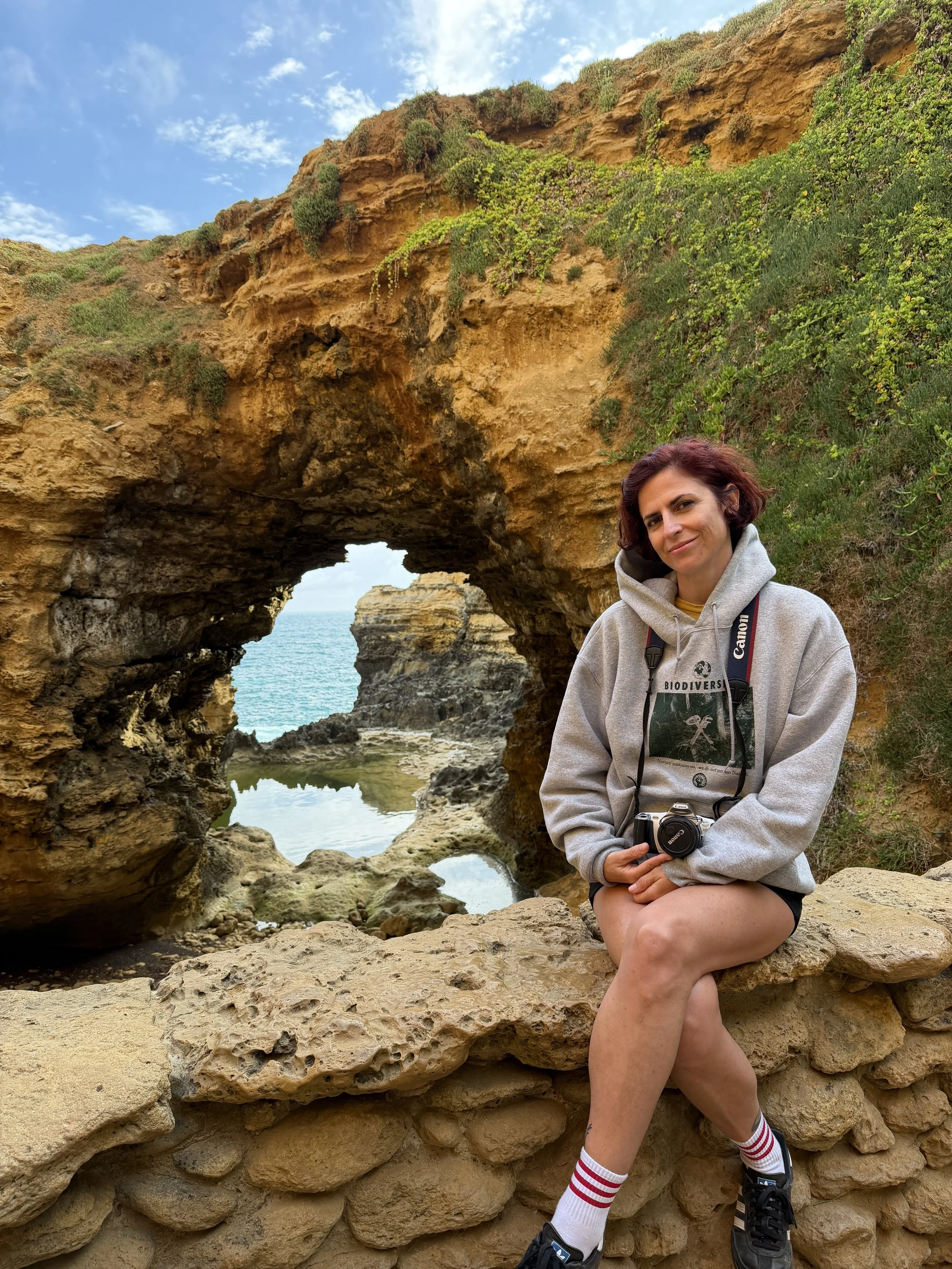
I ask myself continuously throughout the trip what I am curious about, what sparks excitement, and what my heart/mind/body wants. There is nothing more glorious than having nothing on the agenda other than following the thread of your interest. Travel is ideally a pilgrimage back to self. And to complete that piligrimage, one must surrender to their desire. It can feel awkward at first, especially if we have long ignored our own needs in service of others or a master plan. But there are no right or wrong answers, just an ever-evolving process of chosing a direction in which to move forward.
"Travel is about the gorgeous feeling of teetering in the unknown.”—Anthony Bourdain
Connect with others
Other people are portals to other worlds, other ways of thinking and being that may be foreign to our own. I know your mom told you not to talk to strangers. And it’s scary for most people. But research suggests that talking to strangers may make you happier, even if you’re shy. We may draw inspiration and ideas from others; a fresh perspective may expand our mind and open our eyes to possibilities we hadn’t previously considered. Or by experiencing the contrast of how another person thinks and feels, we may come to recognize our own previously unexamined thoughts and feelings as uniquely personal values, meaning, and purpose.
"Go somewhere you’ve never been. Listen to someone you think may have nothing in common with you. Be open to a world where you may not understand or agree with the person next to you, but have a drink with them anyways. Enjoy the ride."—Anthony Bourdain
Get outside your comfort zone
I love to travel but I hate transit. Maybe business class helps but planes, trains, buses etcetera are often rough on the body and spirit. And if there’s one thing you can count on it’s that your trip will at some point go off the rails. Luckily for you, this is where the magic happens. Getting out from under the warm blanket of our routines allows for an expansive mindset which opens our eyes to new possibilities, perspectives, and insights. Discomfort is the cost of transformation.
“Travel isn’t always pretty. It isn’t always uncomfortable. Sometimes it hurts, it even breaks your heart. But that’s okay. The journey changes you; it should change you. It leaves marks on your memory, on your consciousness, on your heart, and on your body. You take something with you. Hopefully, you leave something good behind.”—Anthony Bourdain
Have integrity
While tourism brings an influx of cash, the crowds aren't necessarily good for the local people and more-than-human animals. Whether it's the carbon cost of air travel, Airbnbs skyrocketing the cost of rent, or environmental impacts, the decision to travel is ethically ambiguous at best. So what do I do to try to ameliorate the harm l am causing?
I attempt to practice curiosity and cultural humility, wherein I learn about other cultures while examining my own beliefs and cultural identities. It's often only through the contrast of another culture that we can see our own culturally ingrained beliefs, assumptions and attitudes.
I am respectful and adapt to the local culture, honoring their mores and traditions. I research the destination before I leave, learn the words for please and thank you first, wear appropriate clothes, and follow the rules (even though usually I don't find doing so very fun
And finally I just try not to be a dick. I'm a guest in someone else's home and I try to be conscientious and kind. I don't litter, l always ask people for permission to take their photos, and I try to be aware of and rectify any power imbalances that may arise as the result of global wealth disparity
"It seems that the more places I see and experience, the bigger I realize the world to be. The more I become aware of, the more I realize how relatively little I know of it, how many places I have still to go, how much more there is to learn. Maybe that's enlightenment enough-to know that there is no final resting place of the mind, no moment of smug clarity. Perhaps wisdom, at least for me, means realizing how small I am, and unwise, and how far I have yet to go.”—Anthony Bourdain
Chef, writer, and consummate traveler Anthony Bourdain committed suicide in 2018. Though I didn’t know him personally I suspect that, like many artists, Tony felt things deeply. He was transparent about his struggles with depression, substance abuse, and workaholism. Despite apparently having lived a full life of food, travel, passion, and self expression, he decided to get off this earthly ride early.
His death is a huge loss. Now more than ever our world could benefit from his curiosity, humility, and respect for other cultures. I believe that all of the world’s problems arise from groups of people positioning themselves above others, e.g. humans above nature, men above women, white people above people of color. Travel has helped me recognize my own and others inherent worth as a human beings (not human doings). I have come to see myself and every living thing on this planet as beautifully and inextricably interconnected. By following in the footsteps of Saint Anthony, may all of our explorations take us all to a place of enhanced empathy and desire to alleviate suffering for all living beings.